Table of contents
Buying IPv4 Addresses: Is It the Best Option for Growing Companies?
Have you been impacted by IPv4 exhaustion? Do you believe you must buy IPv4 address space? Discover why you should consider IP leasing as the alternative.

Buying IPv4 addresses requires upfront investment and involves transfer complexity, while leasing provides a more flexible way to access IP resources. As IPv4 demand remains high, companies increasingly evaluate both options to support scalable network growth.
Many organizations still choose to buy IPv4 addresses due to sustained demand and limited supply, with market prices typically ranging between $20-$35 per IP for smaller blocks and lower ranges for larger allocations. However, transfers involve RIR compliance requirements, transaction fees, and upfront capital commitments. For many growing companies, leasing IPv4 addresses offers a flexible alternative – enabling faster access, reduced capital exposure, and predictable operating costs without transferring usage rights. This flexibility is particularly useful for businesses operating large-scale online services, data collection platforms, or infrastructure that relies on solutions such as Proxy-Cheap ISP proxies for reliable connectivity and distributed network access.
Internet Protocol version 4 addresses – commonly referred to as IPv4 – are increasingly scarce yet remain essential for network operations. As demand persists and registry-level supply remains exhausted, organizations face a strategic decision: purchase IPv4 blocks through the transfer market or pursue alternative access models such as leasing.
Leasing has evolved from a niche solution into a structured and widely adopted model for obtaining IPv4 resources. For companies seeking flexibility, speed, or reduced capital exposure, it presents a viable alternative to traditional purchase transfers. So, is IPv4 leasing a game-changer in the industry? Can this option support both IP holders and companies in need of IP resources? How to lease IPv4 successfully? Let’s dive deep into the topic.
Key takeaways
- The global free pool of IPv4 addresses is exhausted, yet demand remains strong, keeping market prices elevated.
- Companies are no longer required to buy IP addresses to support growth and, instead, they can choose to lease IPv4 address blocks at a fraction of the cost.
- Besides saving money on raw IPv4 addresses, those who lease can also significantly cut the costs required to support and maintain the valuable resources.
Buy vs. Lease Calculator
Discover how much you can save by leasing IPs instead of buying!
What has led to IPv4 exhaustion?
The term IPv4 address exhaustion defines the depletion of the globally available pool of IPv4 addresses. The fourth version of the Internet Protocol provides 4,294,967,296 unique addresses, which have proven insufficient to meet long-term global demand. This is because the number of internet users and online devices has grown exponentially since the introduction of IPv4 in 1981.
Unfortunately, businesses today cannot freely acquire IPv4 addresses from Regional Internet Registries (RIR) to expand their networks. Why? The organization responsible for the distribution of IPv4 addresses – the Internet Assigned Numbers Authority (IANA) – assigned the last IP blocks to the RIRs in 2011. As RIRs now have a limited supply of IPv4, they have implemented very strict IPv4 allocation policies.
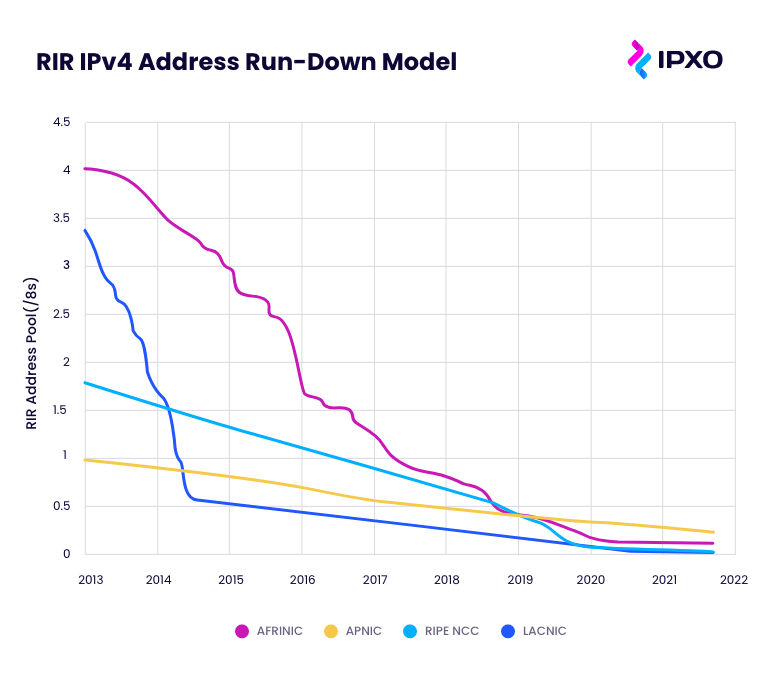
Another version of the Internet Protocol – IPv6 – came to the rescue offering 340 trillion trillion trillion unique combinations – more than 100 times the number of atoms on the surface of the Earth. In theory, it is unlikely that we would ever run out of IPv6 addresses.
However, despite steady progress, IPv6 adoption remains gradual due to infrastructure complexity, legacy system dependencies, and transition costs. As a result, many organizations continue to rely on IPv4 addresses, which have become a scarce commodity. This has paved the way for secondary markets, in which internet numbers are leased or bought.
Is buying IP addresses an outdated solution?
Not every business considering buying IPv4 addresses is aware of other options available. IPv4 leasing emerged as an alternative to IP address buying. But is IP lease better than IP purchase? Let’s examine this from a few different perspectives:
- IP resource transfer process
- IPv4 pricing
- IP address management
Lengthy IP address transfer process
The scarcity of IPv4 addresses influenced the rise of the IPv4 address transfer market. In this secondary market, organizations can transfer their unused resources to other institutions or businesses that require them. Companies seeking to transfer or acquire IPv4 blocks have to contact a RIR directly or use IPv4 broker services. However, transferring usage rights to IPs is a long and complicated process.
A business must comply with its RIR’s policies to obtain IPv4 blocks through a transfer. Regional Internet Registries that facilitate transfers implement structured review and pre-approval procedures to ensure that buyers qualify under current allocation policies. For example, organizations are required to justify their operational need for IPv4 resources.
The pre-approval process may take several days; however, the entire transfer process can extend to two or three weeks, depending on registry timelines and documentation requirements. Also, RIRs may apply transfer fees to the seller and the buyer based on the size of the block. For example, the transfer fee for the IPv4 address space starts from $500 at ARIN – the American Registry for Internet Numbers.
In contrast, leasing is a simpler process that may take only a few days. For example, on the IPXO Platform, verified IP lessees can lease within 5 minutes and bring the resources to any infrastructure within 24 hours. For companies that require rapid scalability, leasing IPv4 blocks can provide faster access compared to traditional purchase transfers.
Competitive pricing
If you consider buying IPv4 address blocks, the required capital investment can be significant. While IPv4 prices rose sharply in previous years, the market shifted toward the end of 2025, with prices softening compared to earlier peak levels. In current market conditions, IP address prices range between $20–$35 per IP for a /24 block with pricing varying by region, block size, and address history. As the market moves into 2026, prices are expected to remain relatively stable, with fluctuations driven by regional demand and available supply. While this reflects a more stable market compared to previous highs, purchasing IPv4 still requires substantial upfront capital. Depending on how many IPs you need, total purchase costs can quickly reach substantial levels.
IP leasing offers a more cost-efficient solution. At IPXO – the world’s first fully automated IP lease, monetization, and management platform, IPv4 addresses can be leased for as little as $0.29 per month. Every IP holder can set and offer competitive pricing, which further benefits IP lessees.
Another key advantage of leasing is reduced upfront capital exposure. Because you do not need to invest considerable funds in advance, those resources can instead be allocated to other essential investments that support business growth.

Resource burden
When you buy an IP block, you acquire valuable resources that allow you to extend your business network. You may also have the opportunity to turn your assets into profit if you decide to sell them at a higher price in the future once you no longer need them.
However, when you purchase a lot of IPs, you need to take into account the resources required to manage a large inventory of IPv4 blocks. If managing IPs becomes too time-consuming and costly, buying IPv4 may be a long-term commitment that does not deliver the expected return.
On the other hand, when you lease IPv4 address blocks, you enter into a fixed-term agreement. This might be a better alternative if you prefer flexibility rather than making a long-term purchase. For example, you can lease for as short as a month or two, or you can sign a Commitments agreement after negotiating favorable lease terms and pricing.
IP reputation and protection
IP sellers may not apply all security measures to protect buyers from such IP issues as IP blocklisting. Because monitoring standards vary between sellers, tracking address usage and ensuring legitimate use is not always consistent. As a result, a potential buyer could unknowingly purchase blocklisted IPs that are unusable.
At IPXO, we take IP reputation seriously. Our Abuse Prevention team performs daily checks to ensure that all IPs listed on the Platform are clean. We also thoroughly screen our clients, both IP holders and lessees, to guarantee that IPs are valid and safe to use in any network or infrastructure before they are added to the Platform. In short, IP address abuse observability is a priority for us.
To further strengthen security, IPXO implements the Resource Public Key Infrastructure (RPKI), which secures Border Gateway Protocol (BGP) routing and helps prevent IP hijacking. In other words, RPKI verifies that IPXO lessees receive valid IP resources from legitimate holders.
Buy IP addresses vs. lease IP addresses: The weigh in
Purchasing IPv4 addresses can be expensive and complicated. Why? For one, the IPv4 block transfer process is time-consuming, which may discourage buyers who want to scale their business quickly. Furthermore, IP sellers usually transfer resources to the highest bidder. Therefore, high prices may encourage small or medium-sized companies to search for other solutions.
IPv4 leasing offers benefits that support business growth quickly and cost-efficiently.
The IPXO Platform offers affordable IPv4 block leasing for clients that need flexibility and speed. Small and medium-sized companies can find IPs from all RIRs, search for resources by price, and negotiate custom lease conditions. For example, many companies prefer leasing without long-term commitments. Most importantly, IP lessees can lease instantly without having to worry about whether the resources are reputable.
Interested in giving IP leasing a try? Then register your free account today. Are you still unsure whether to buy or lease? Let’s connect and discuss the details! You can contact us and get expert advice by booking a demo.
Your #1 IP lease platform
Fully automated. Fully accessible. Fully supported.
FAQ about buying IPv4 addresses
The price per IPv4 address for buyers can be anywhere from $20 to $35 on average. However, this price does not include the additional fees that come with transferring and maintaining IP addresses. For example, the transfer costs start at $500 at the American Registry for Internet Numbers (ARIN). If you use a broker to handle the purchase and transfer process, you must also pay a brokerage fee. Once IPs are in your possession, you may need to hire a professional or train your own in-house team to manage your newly acquired resources.
About the author

Beatrice Rasciute
Technical Content Writer
Related reading

Static vs Rotating IPs: Which Strategy Wins for Automation and Data Collection?
Guest post by IPRoyal Data collection requires a clear, well-thought-out plan, and you’ll need reliable tools to gather information successfully from modern websites. Choosing the…
Read more
What’s Happening to the Global IPv4 Address Pool Today?
The global IPv4 address pool is no longer expanding, yet internet infrastructure continues to grow. Understanding how address distribution, routing behavior, and resource management evolve after IPv4 exhaustion is…
Read more
IP Fragmentation: The Invisible Problem Costing Operators Millions
IPv4 fragmentation builds slowly as networks evolve, leaving organizations with scattered address space, reduced visibility, and growing operational complexity.
Read more
Subscribe to the IPXO email and don’t miss any news!